Start Date: Sunday, 21st of July, 19:00
Approximate Work Hours: 6.5
Balancing Enemies in a Multiplayer Roguelike Game
Game Brief:
- Max number of players: 4
- Number of Different Runs: 6
- Core combat and gameplay with deeper meta-progression.
- Rooms are randomly pulled from a pool, with encounters featuring monsters with basic and experienced variations.
Problem:
- Current method scales up HP, movement speed, and damage of monsters based on the number of players.
- Feedback indicates this feels monotonous and unfair.
The solutions I provide, will be designed to be easier to implement, with minimal dependency on existing enemy types.
Instead of complex role-based systems like Tank, DPS, and Support, which might not fit all enemies, I offer global behavioral solutions that can be applied broadly
Solution 1: Simple Adaptive Behavior
Description:
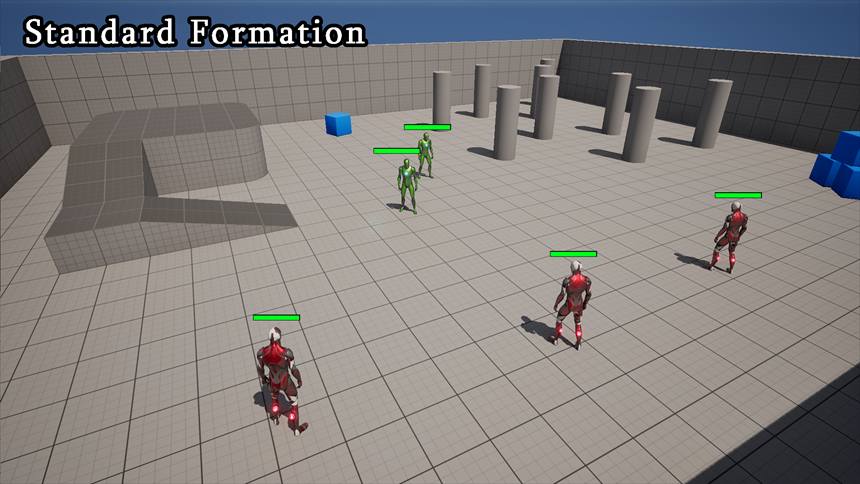
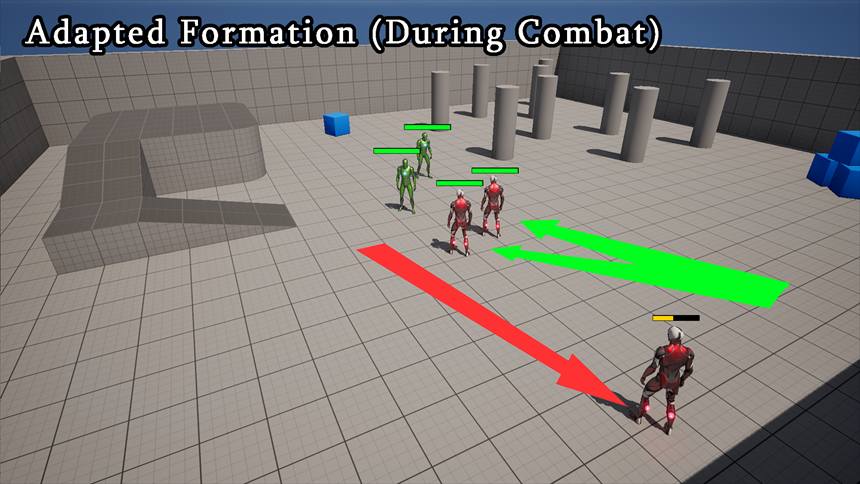
Implement adaptive AI behavior, which makes high health enemies move towards the player, while low health ones try to stay out of their effective range. This will add an interesting rotation to how the enemies behave, based on who has the advantage.
Multiplayer Aspect: This could be adjusted to have the enemies target players with the lowest health. Essentially, this change will make the enemies smarter, instead of increasing their flat stats.
Advantages & Disadvantages:
Advantages:
- Quicker / easier to implement than other solutions
- This behavior could just be implemented into the base enemy class, or its abstract class, and will work regardless of enemies movesets, as long as they can move.
- Will make the enemies seem more strategic
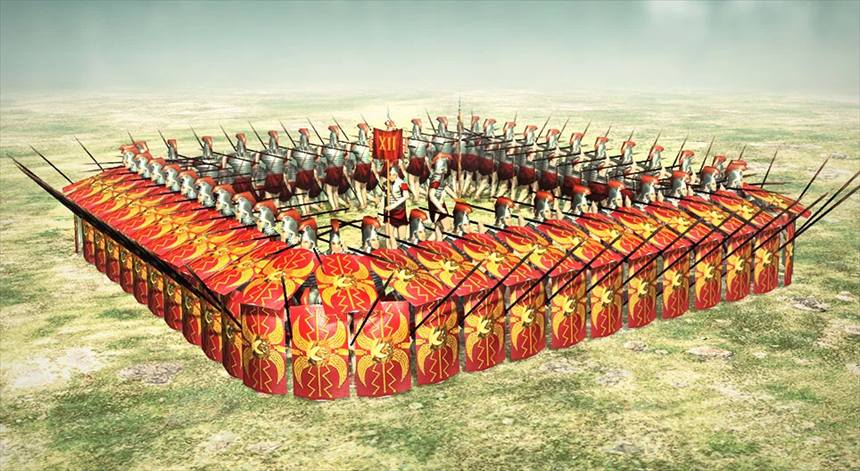
- One inspiration of this solution, is the Roman “Turtle” strategy, during which soldiers would swap their positions to those holding the spears, based on how tired they were. At the time of its invention, this strategy had no equals.
Disadvantages:
- Scalability
- While this solution is interesting, it does not scale well. If there are more than 2-3 difficulty levels, or “New Game+” possibilities, this feature alone will not help the difficulty. This should be used at a time when there is lack of time, and a noticeable change is needed, quickly. Otherwise, this should be just one of many difficulty modifiers, instead of the main one.
References:
- Left 4 Dead: Uses AI to direct enemy focus based on player health and actions, providing a reference for adaptive targeting behavior. This was met with very positive feedback.
Production Pipeline:
- Design Phase:
- Define variables such as: Health Thresholds, Movement Ranges, Movement Speeds.
- Create initial AI prototypes with basic adaptive capabilities.
- Development Phase:
- Develop and integrate adaptive AI behaviors.
- Conduct extensive playtesting to balance AI and challenges. Check how navigation works on such interactions. Enemies might collide with each other, or hinder the ability to navigate correctly, if pathing is not checked.
- Iteration Phase:
- Collect player feedback and adjust AI behaviors.
- Fine-tune and test again.
Solution 2: Opportunistic Enemies
Description:
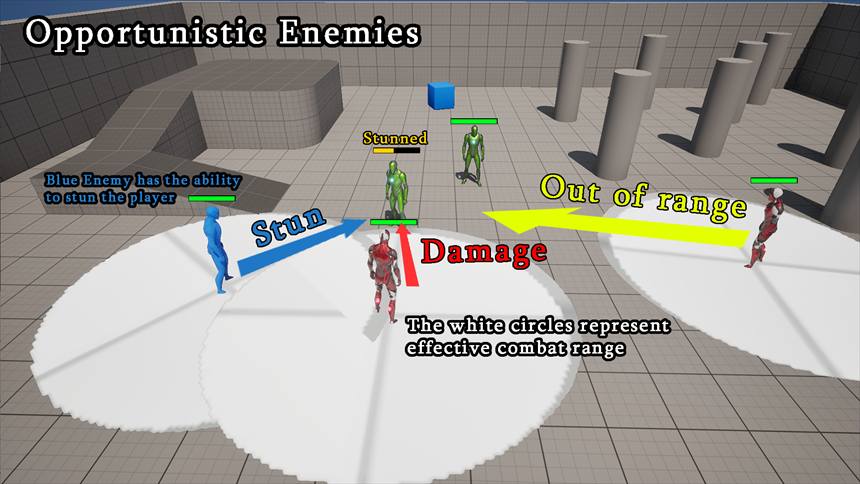
Enemies coordinate their attacks. When the player is slowed, or stunned, nearby enemies target them to make the most of that opportunity.
Multiplayer Aspect: Similarly, enemies who can slow, stun, or immobilize, target healers or players who are contributing the most to the party.
Advantages & Disadvantages:
Advantages:
- Incentivizing Strategy: Once players understand this behavior, they will be incentivized to form better strategies, and defend their party members when they are targeted.
Disadvantages:
- Implementation: Designing and balancing coordinated attacks requires careful planning. If a player is bursted down while they are unable to move, they will get frustrated.
- That’s why it is also important to add additional options of getting out of crowd control.
A minigame of “Mash Left Click” or something similar, that would help the player get out of the stunned state in half the time, while also giving them Invincibility frames for 0.5 seconds once they get out, would help.
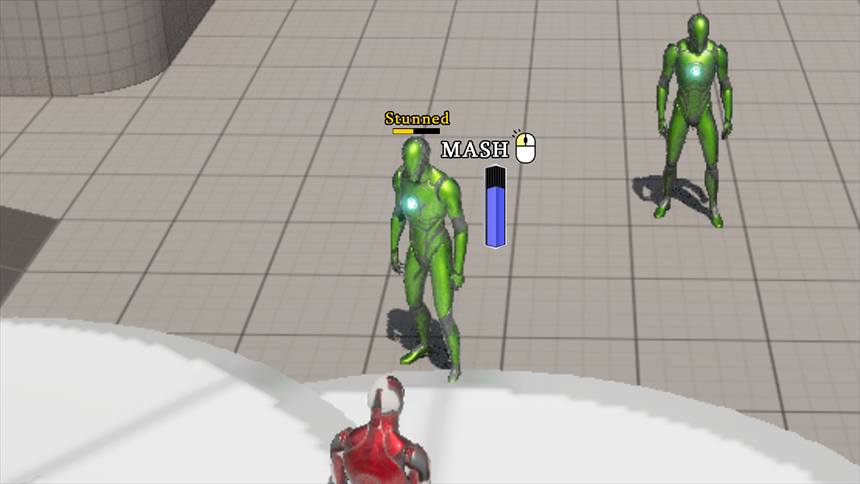
- Adding “Cleansing” abilities or consumables that remove slows or stuns would also be needed. While this adds another layer to the metagame, it could me a misfit, based on how the current abilities are designed.
References:
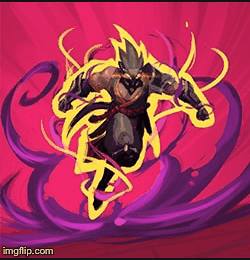
- Koga from Paladins, Shadow Step (Video Opens the exact time) Paladins - Ability Breakdown - Koga, The Lost Hand
- Zhin from Paladins, Billow Paladins - Zhin - Ability Breakdown
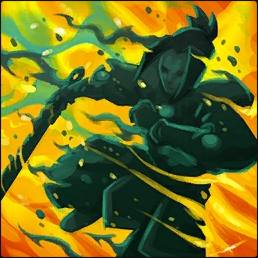
- Learning Curve: Players may need time to adapt to meta that will be created by this difficulty spike.
Personal Opinion:
Coordinated attacks enhance strategic depth and provide a new challenge for the players. The implementation complexity is manageable and can lead to more engaging and varied gameplay, but this should only be done after great consideration of if it fits the game’s vision and game loop.
Production Pipeline:
- Design Phase:
- Define crowd control attack types.
- Example: Add a tag to each attack - Neutral, Soft CC, Hard CC, Inescapable.
- Define how coordinated attacks work.
- Example: Range Of Action variable of range from which an enemy can decide to follow up once the player is under CC, Follow up Frequency - How frequently each enemy can do a follow up, should be around 1 per minute per enemy.
- Development Phase:.
- Implement coordinated attack patterns.
- Conduct playtesting to balance attacks, their frequency and range.
- Iteration Phase:
- Collect player feedback and adjust variables accordingly.
- Fine-tune balance based on testing results.
Team Composition Analysis
Team Composition One:
1 Lead Designer
2 Mid-level Designers
5 Junior Designers
Solution 1: Simple Adaptive Behavior
Lead Designer:
The Lead Designer will define the vision and parameters for adaptive AI behaviors, including setting health thresholds, movement dynamics, and overall balance to align with the game’s design. They will oversee the development and ensure the AI behaves strategically as envisioned. The Lead Designer will regularly communicate design goals to the Mid-level Designers and provide high-level feedback to Junior Designers based on playtesting results. They will report progress and major issues to Project Managers.
Mid-level Designers:
Mid-level Designers will focus on implementing (Design wise) the adaptive AI behaviors. They will work on detailed design, ensuring these behaviors fit well with existing AI systems and function correctly. Their role will include conducting initial testing and adjusting behaviors based on performance. They will coordinate closely with the Lead Designer to align their work with the overall design vision and with Junior Designers to facilitate testing and gather feedback. They will report to the Lead Designer on implementation progress and any technical issues encountered.
Junior Designers:
Junior Designers will primarily conduct playtesting to evaluate the effectiveness of the adaptive AI behaviors. They will gather data, identify bugs, and suggest minor adjustments based on their testing. Their communication with Mid-level Designers will involve sharing detailed reports on testing outcomes and issues. They will report to the Lead Designer, highlighting significant feedback or problems that could impact the overall design or balance.
Solution 2: Opportunistic Enemies
Lead Designer:
For the Opportunistic Enemies solution, the Lead Designer will define the core mechanics for coordinated attacks and crowd control. They will ensure these new mechanics align with the game’s design goals and fit seamlessly into existing systems. The Lead Designer will provide strategic direction and feedback based on playtesting results and will communicate any major updates and challenges to Project Managers.
Senior Designer:
The Senior Designer will be responsible for developing and refining the mechanics of coordinated attacks and crowd control. They will handle complex design aspects and ensure these mechanics are well-integrated and balanced within the game. Their role will involve collaborating closely with the Lead Designer to address high-level issues and working with the Mid-level Designer to test and refine the mechanics based on feedback. They will report to the Lead Designer on development progress and major changes.
Mid-level Designer:
The Mid-level Designer will assist in implementing and fine-tuning the mechanics for coordinated attacks and crowd control. They will focus on detailed design work, initial testing, and balancing these features. Their role will include providing feedback to the Lead and Senior Designers on the performance and integration of these mechanics. They will ensure smooth implementation and make recommendations for adjustments based on playtesting results, reporting findings and any issues to both the Lead and Senior Designers.
Summary for Team Composition One:
With a larger team, the Lead Designer can focus on high-level design and coordination of the new mechanics, while the Senior Designer handles the complex implementation details. The Mid-level Designers will be able to focus on specific aspects of testing and balancing, allowing for a more detailed and thorough development process. Junior Designers will support with playtesting and feedback, facilitating iterative improvements.
This allows for a more segmented approach, where each designer can focus on their specific tasks, resulting in potentially quicker iterations and more thorough testing.
Team Composition Two:
1 Lead Designer
1 Senior Designer
1 Mid-level Designer
Solution 1: Simple Adaptive Behavior
Lead Designer:
In a smaller team, the Lead Designer will be primarily responsible for defining and overseeing the adaptive AI behaviors. This includes setting key parameters such as health thresholds and movement ranges, and ensuring these behaviors align with the overall game design. They will work closely with the Senior Designer to maintain the design vision and provide guidance based on playtesting results. The Lead Designer will also keep Project Managers informed of progress and significant issues.
Senior Designer:
The Senior Designer will assist with the detailed design and refinement of adaptive AI behaviors. They will handle complex aspects of AI behavior and ensure these features integrate well with existing systems. Their role will involve collaborating with the Lead Designer to address high-level issues and providing feedback to the Mid-level Designer based on implementation and testing results. They will report to the Lead Designer on development progress and any significant changes.
Mid-level Designer:
The Mid-level Designer will focus on implementing and fine-tuning adaptive AI behaviors. They will conduct testing, gather feedback, and make adjustments based on performance data. They will work closely with both the Lead and Senior Designers to ensure the implementation aligns with design goals and technical requirements. They will report on testing outcomes and any issues encountered, ensuring the behaviors meet the desired standards.
Solution 2: Opportunistic Enemies
Lead Designer:
For the Opportunistic Enemies solution, the Lead Designer will be responsible for conceptualizing and defining the mechanics for coordinated attacks and crowd control. They will ensure these elements fit into the game’s design and provide strategic direction based on playtesting feedback. They will communicate progress and major issues to Project Managers and ensure alignment with the overall game vision.
Senior Designer:
The Senior Designer will handle the development and balancing of the mechanics for coordinated attacks and crowd control. They will address complex interactions and ensure the mechanics function effectively within the game. They will collaborate closely with the Lead Designer to resolve major issues and work with the Mid-level Designer to refine the mechanics based on feedback. They will report to the Lead Designer on development progress and any significant changes.
Mid-level Designer:
The Mid-level Designer will support the implementation and fine-tuning of coordinated attack and crowd control mechanics. They will focus on detailed design, initial testing, and balancing of these features. Their role will include providing feedback on performance and integration, ensuring the mechanics are well-implemented and making recommendations for adjustments based on playtesting results. They will communicate their findings and any issues to both the Lead and Senior Designers.
Summary for Team Composition Two:
In a smaller team, the Lead Designer will focus on defining the core mechanics and strategic vision for new features. The Senior Designer will handle the complex aspects of development and balancing. The Mid-level Designer will manage detailed tasks and testing. The smaller team size requires efficient communication and coordination, with each designer taking on a broader range of responsibilities to ensure successful implementation and integration.
With a smaller team, the Lead Designer will handle a larger portion of the design and oversight duties. The reduced team size may result in fewer resources for testing and refinement, potentially leading to longer iteration times and a need for more efficient communication.