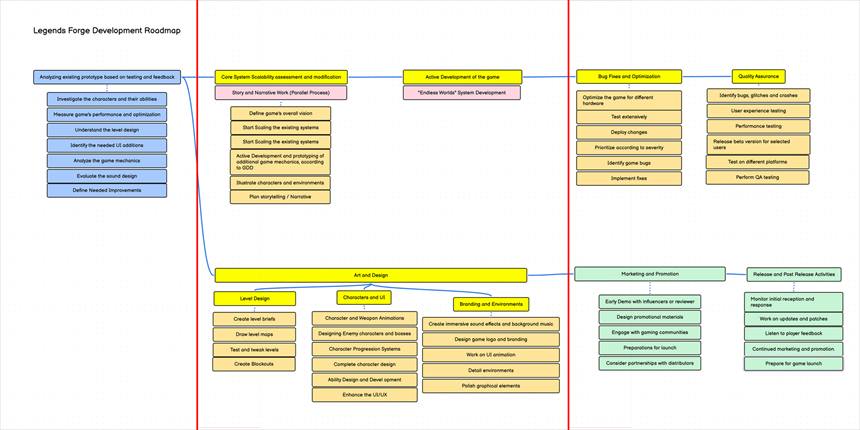
Legends Forge Development Roadmap
Month 1: Initial Analysis and Planning
- Analyze Existing Prototype: Gather and review feedback from testing.
- Core System Scalability Assessment: Evaluate and modify core systems for scalability.
- Define Game’s Overall Vision: Outline the overarching goals and vision for the game.
- Investigate Characters and Abilities: Research and refine character abilities.
Month 2: Core System Development and Design
- Start Scaling the Existing Systems: Begin scaling core systems based on assessment.
- Story and Narrative Work (Parallel Process): Develop and integrate the game’s story and narrative.
- Understand Level Design: Review and understand current level design strategies.
- Identify Needed UI Additions: Determine additional UI requirements.
Month 3: Mechanics and Performance
- Analyze Game Mechanics: Deep dive into game mechanics and refine as necessary.
- Measure Game’s Performance and Optimization: Assess performance metrics and start optimization.
- Evaluate Sound Design: Review and enhance the sound design for the game.
Month 4: Design and Prototyping
- Active Development and Prototyping of Additional Game Mechanics: Develop and prototype new mechanics per the Game Design Document (GDD).
- Illustrate Characters and Environments: Begin creating illustrations for characters and environments.
- Plan Storytelling/Narrative: Finalize storytelling elements and narrative integration.
Month 4: Art and Development
- Art and Design: Continue with detailed art and design work for characters and environments.
- Character and Weapon Animations: Develop animations for characters and weapons.
- Designing Enemy Characters and Bosses: Create designs for enemy characters and bosses.
Month 5: System Enhancements and Testing
- Start Scaling Existing Systems: Continue scaling systems as needed.
- Character Progression Systems: Implement and test character progression systems.
- Enhance the UI/UX: Improve user interface and experience based on feedback.
- Quality Assurance: Begin initial QA testing to identify and address bugs.
Month 5: Level Design and Additional Mechanics
- Level Design:
- Create level briefs.
- Draw level maps.
- Test and tweak levels.
- Create blockouts.
- Active Development of the Game: Continue developing the game with integrated mechanics.
- "Endless Worlds" System Development: Develop and integrate the Endless Worlds system.
Month 6-10: Active Development
Month 9: Testing and Optimization
- Bug Fixes and Optimization:
- Optimize the game for different hardware.
- Identify and fix bugs, glitches, and crashes.
- Perform user experience testing.
- Conduct performance testing.
- Release Beta Version for Selected Users: Deploy the beta version for testing.
- Identify Game Bugs: Compile a list of bugs for fixing.
Month 9: Marketing and Promotion
- Marketing and Promotion:
- Design promotional materials.
- Engage with gaming communities.
- Prepare for game launch.
- Early Demo with Influencers or Reviewers: Share early demo with key influencers and reviewers.
- Create Immersive Sound Effects and Background Music: Finalize sound effects and music.
Month 10: Final Preparations
- Prepare for Game Launch: Finalize preparations for the game’s launch.
- Design Game Logo and Branding: Complete game branding and logo design.
- Work on UI Animation: Implement and refine UI animations.
- Detail Environments: Finalize environment details and graphical elements.
Month 11: Release and Post-Release Activities
- Release and Post-Release Activities:
- Deploy game to all platforms.
- Monitor initial reception and response.
- Work on updates and patches based on feedback.
- Listen to player feedback for future improvements.
- Consider Partnerships with Distributors: Explore and finalize distribution partnerships.
- Continued Marketing and Promotion: Maintain marketing efforts and community engagement.